The Biggest Classroom Problem Isn't Technology—It's Uniformity
The Worksheet Was Never the Problem. The One-Size-Fits-All Classroom Was.
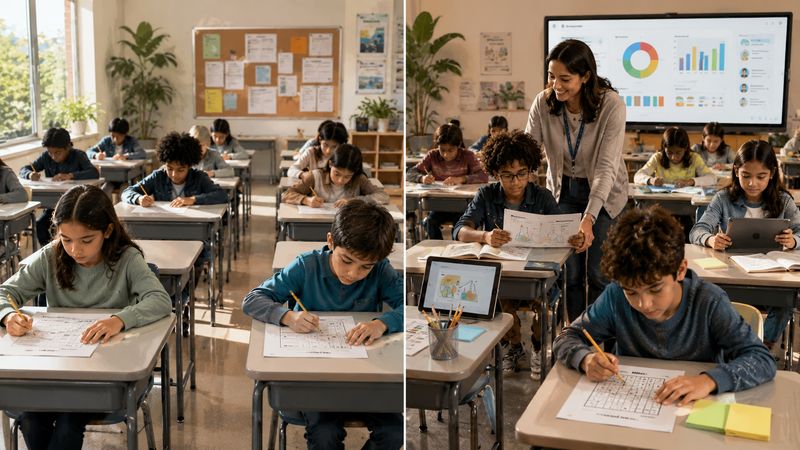
Walk into almost any classroom, and you'll see students working on the same assignment, answering the same questions, and completing the same worksheet.
At first glance, it seems fair. Everyone receives the same instruction and the same opportunity to learn.
But fairness and effectiveness aren't always the same thing.
Imagine asking every child to wear the same shoe size because it's easier to manage. Some would struggle to walk, while others would find the shoes too loose to be useful. We instinctively recognize how impractical that would be. Yet in education, we often expect students with different strengths, learning styles, and levels of understanding to learn from identical practice materials.
Perhaps the biggest challenge facing today's classrooms isn't a lack of technology. It's the expectation that one learning experience can serve everyone equally well.
Teachers Already Know Students Learn Differently
No teacher walks into a classroom believing every student learns at the same pace.
Some students grasp new concepts almost immediately. Others need repetition, visual examples, or extra practice before the lesson truly clicks. Some thrive when solving challenging problems, while others need smaller, confidence-building steps.
The issue has never been a lack of awareness.
It's a lack of time.
Differentiating instruction for twenty or thirty students requires creating multiple versions of activities, adjusting difficulty levels, and finding resources that suit different learning needs. Between lesson planning, grading, meetings, and classroom management, that's simply not realistic every day.
As a result, many educators rely on generalized worksheets designed to work reasonably well for everyone—but perfectly for almost no one.
We've Been Solving the Wrong Problem
For years, educational conversations have focused on improving classroom technology.
Should schools buy more devices?
Which apps are worth using?
How can AI fit into teaching?
These are important questions, but they overlook a more fundamental issue.
Technology isn't the biggest obstacle to meaningful learning.
Uniformity is.
When every student receives the same practice regardless of readiness, learning becomes a compromise. Students who need more support may fall behind, while those ready for greater challenges often become disengaged.
The problem isn't the worksheet itself.
It's expecting a single worksheet to meet every learner's needs.
AI Makes Personalization Practical
Personalized learning has been discussed in education for decades, but it has often remained an ideal rather than a practical reality.
Creating customized learning materials manually takes time that most educators simply don't have.
This is where artificial intelligence offers something genuinely valuable.
Instead of replacing teachers, AI can reduce the repetitive work involved in preparing classroom resources. It can help generate differentiated activities, adapt practice for varying skill levels, and produce fresh exercises without hours of manual formatting.
That shift changes what personalization looks like in everyday classrooms.
Rather than spending evenings creating multiple versions of the same assignment, teachers can focus on supporting students, answering questions, and building meaningful learning experiences.
Technology Should Give Teachers More Time to Teach
The best educational technology doesn't ask teachers to redesign their entire workflow.
It quietly removes repetitive tasks.
That's why practical AI tools are becoming increasingly valuable. Instead of searching across multiple websites or editing printable templates one by one, educators can generate learning materials tailored to specific classroom goals.
For example, Brainator allows teachers, tutors, and parents to create customized printable worksheets in just a few minutes. A science teacher preparing a lesson can generate differentiated activities with Brainator's Science Worksheet Generator, while also creating engaging critical-thinking exercises using the Sudoku Worksheet Generator to encourage logical reasoning and problem-solving.
The technology isn't replacing the teacher's expertise.
It's helping teachers spend more of their energy where it matters most—working directly with students.
The Future Classroom Won't Be More Digital. It Will Be More Flexible.
The conversation around education often frames technology as the future.
But the future isn't simply about more screens or smarter software.
It's about flexibility.
Imagine a classroom where students working on the same concept receive practice designed for their individual level of understanding. A struggling learner gains confidence through foundational questions, while another student is challenged with more advanced applications of the same topic.
The lesson remains shared.
The path becomes personalized.
That kind of adaptability has always been the goal of effective teaching.
Now, it's becoming practical.
Great Teachers Have Always Been the Difference
No algorithm can replace encouragement after a difficult lesson.
No software can recognize the quiet student who finally gains confidence to participate.
No automated system can build trust, curiosity, or meaningful relationships.
Those remain deeply human responsibilities.
The most promising role for AI isn't taking over classrooms.
It's removing repetitive work so teachers have more opportunities to do what inspired them to teach in the first place.
Final Thoughts
The biggest classroom challenge has never been a shortage of technology.
It has been the assumption that every student benefits from exactly the same learning experience.
As classrooms become more diverse, that assumption becomes harder to defend.
Artificial intelligence won't solve every educational challenge, but it can remove one of the biggest barriers to personalized learning: time.
When educators have practical tools that simplify resource creation instead of adding more work, they gain something far more valuable than efficiency.
They gain the freedom to teach every student—not just the average one.
Comments
No comments yet. Be the first to comment!